On this page
- The creative hit rates you see quoted measure different things
- A "winner" in these datasets is where Meta put the money
- How many ad creatives to test depends on how sure you want to be
- For smaller accounts the constraint is weeks, not ad count
- The math only holds if each ad tests a different idea
- How to calculate how many ads your account should test
- Make the concepts you need
- Frequently asked questions
The number most guides quote for Meta creative testing comes from Motion's 2026 benchmark: about 5% of creatives become winners, or 1 in 20. It's a real figure from a large dataset, but it hides two things: what counted as a winner, and how sure you want to be of finding one. At a 5% creative hit rate, testing 14 distinct ads gives you roughly a coin-flip chance of at least one winner. A 90% chance takes 45. And those numbers only hold if each ad tests a different idea.
A creative hit rate (agencies often call it a creative win rate) is the share of launched ads that meet a chosen definition of "winner." Change the definition and the rate moves by almost an order of magnitude, which is why published figures run from 0.9% to 8.8%.
At AdSmash, an AI ad creative platform, we treat the production side of this math as the real constraint: the number of distinct concepts a team can make each week sets how fast it finds a winner. The sections below start from the published data and return to production at the end.
The creative hit rates you see quoted measure different things
| Source | Dataset | What counts as a winner | Hit rate |
|---|---|---|---|
| Motion, Creative Benchmarks 2026 | 578,750 creatives, 6,015 accounts, $1.29 billion Meta spend, Sep 2025–Jan 2026 | Spends at least 10× the account's median creative and at least $500 | About 5% overall; 4.0% to 8.8% by spend tier |
| Common Thread Collective, podcast transcript, Jul 2026 | 504 stores, $3.35 billion Meta spend, 365 days, 7-day click | A "whale": an ad driving a disproportionate share of results | 0.9%, roughly one in a hundred ads |
| Admiral Media, Jun 2026 | AI-generated ad variants in accounts the agency manages; sample size, time window and method not published | A variant that reaches and holds scale | 6 to 7 percent |
None of these is wrong. They answer different questions. Common Thread's whale is close to "an ad that carries the account," so it is rare. Motion's winner is "an ad the account leans on far more than its typical ad," a lower bar. Admiral's figure reflects the agency's own judgment of scale in its own accounts, so it isn't directly comparable to either dataset.
Our view is that you should plan with the definition closest to how your team already decides an ad has won. If you call an ad a winner when it becomes one of the two or three that carry the account, plan with something nearer Common Thread's 0.9% than Motion's 5%.
A "winner" in these datasets is where Meta put the money
Both large datasets define winners by spend, not by profit. Motion's methodology says its benchmarks describe spend concentration and creative longevity, not ROAS, CPA or revenue, and that the findings are "associations, not causation."
That matters for how you read the 5%. Meta's delivery system decides which ads in an ad set get budget, and it concentrates spend. In Motion's data, 55% of spend goes to winning creatives, and about half of all ads receive little or no spend. In Common Thread's data, only 74% of ads got any spend at all, and 23.8% cleared $100.
Two consequences follow. First, an ad that got almost no spend wasn't really tested; the auction passed on it early. Second, a spend "winner" is the ad Meta preferred. We'd expect that to track performance in most accounts, but Motion's data can't show it. Before you scale an ad because it crossed a spend threshold, check its CPA or ROAS against your target over the same window. If clicks arrive but sales don't, seven common causes are worth ruling out first.
How many ad creatives to test depends on how sure you want to be
Most guides convert a hit rate into a test count by dividing: a 5% rate means test 20, a 10% rate means test 10. RocketShip HQ's calculator page states it directly: "At a 10% win rate, you need to test 10 creatives to find 1 winner." That is the expected number of tests per winner, not a guarantee. By our calculation, 10 tests at a 10% rate produce at least one winner only about 65% of the time.
The useful question is how many distinct tests you need for a given probability of at least one winner. If each test has the same chance p of winning and the tests are independent, the answer is:
n = ln(1 − confidence) ÷ ln(1 − p), rounded up
By our calculation, this is what that gives at Motion's 5% rate and at Common Thread's 0.9% whale rate:
| Chance of at least one winner | Tests needed at 5% (Motion winner) | Tests needed at 0.9% (CTC whale) |
|---|---|---|
| 50% | 14 | 77 |
| 80% | 32 | 179 |
| 90% | 45 | 255 |
| 95% | 59 | 332 |
Run backwards, the same math checks small batches. By our calculation, at a 5% rate, 5 tests find a winner about 23% of the time, 10 tests about 40% of the time, and 20 tests about 64% of the time. A team that launches five ads, sees no winner and concludes "our creative isn't working" has learned very little: that outcome happens about three times out of four even when nothing is wrong.
For smaller accounts the constraint is weeks, not ad count
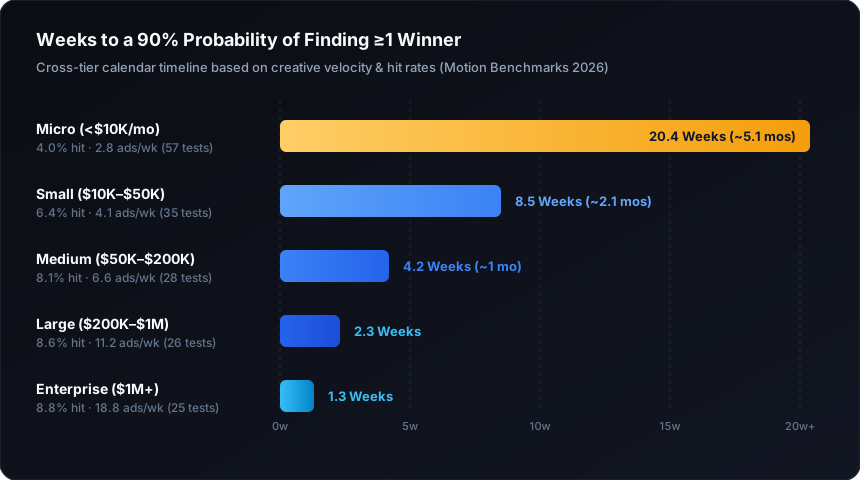
Motion's report breaks hit rate and testing volume out by monthly Meta spend in its scale and volume section. Combining each tier's hit rate with how many new creatives it launches per week gives the calendar time needed for a 90% chance of at least one winner. The last two columns are our calculation.
| Tier (monthly Meta spend) | Hit rate | New creatives per week | Tests for a 90% chance | Weeks at that pace |
|---|---|---|---|---|
| Micro (under $10K) | 4.0% | 2.8 | 57 | 20.4 |
| Small ($10K–$50K) | 6.4% | 4.1 | 35 | 8.5 |
| Medium ($50K–$200K) | 8.1% | 6.6 | 28 | 4.2 |
| Large ($200K–$1M) | 8.6% | 11.2 | 26 | 2.3 |
| Enterprise ($1M+) | 8.8% | 18.8 | 25 | 1.3 |
Another page of the same report puts Micro at about 3.8% and Enterprise at about 8.2%. At 3.8%, a Micro account needs 60 tests, or about 21.4 weeks, so the conclusion holds either way.
Across tiers, hit rate rises about 2.2× from Micro to Enterprise, while weekly launch volume rises about 6.7×. Within a spend tier, Motion reports that per-creative hit rate is "remarkably stable across volume levels." Read together, these suggest larger accounts find more winners mainly because they run more tests per week, not because each ad is several times more likely to win. Motion is clear these are associations, so treat that as the most likely explanation rather than a proven one.
If you can produce three distinct concepts a week, judging your creative program after a month means judging it on about a dozen tests, where finding no winner is the likely outcome.
Production capacity is where a platform like AdSmash earns its place. According to the AdSmash homepage, its managed service can deliver 15 to 20 ads a week from a brief, several times the 2.8 to 4.1 new creatives that Motion reports Micro and Small accounts launch. Those are ads, not necessarily distinct concepts, so the brief still has to carry different ideas.
The math only holds if each ad tests a different idea
The tests-needed formula above assumes independent tests. In ad terms, each ad has to stand or fall on its own idea. Ten color variations of one script are one test, not ten: if the hook doesn't land, it fails in all ten. Our view is that changes in between, like a new hook or format on the same script, count as part of a try rather than a full one.
This is where the "test more" camp and the "test fewer, better" camp both have a point. AdLibrary argues that 3–6 role-differentiated creatives beat 50 near-identical variants, because near-duplicates split delivery without adding information. The volume argument holds too. Motion's own illustration compares an account with 5 launches and 1 winner (a 20% hit rate) to one with 50 launches and 5 winners (10%). The second account has five times the winner output.
Both hold if you count concepts rather than ads. The number that belongs in the formula is distinct ideas (a different angle, hook, format or audience promise), not uploads. For how AI changes the production side, see our overview of AI-generated advertising. Variants of a proven concept are still worth producing, but they belong to iteration on a winner, not to the search for one.
This is the step where AdSmash's ad creative intelligence helps. It breaks a winning ad into its parts using roughly 60 to 70 signals, and one click turns the teardown into a brief for a new concept. It is available on every plan, including Free.
How to calculate how many ads your account should test
- Pick your winner definition. Use the one that matches how your team actually decides to scale an ad. That might be a spend threshold like Motion's, a share-of-results bar like Common Thread's, or a CPA or ROAS target held at scale.
- Measure your own hit rate. Over your last quarter, count distinct concepts launched and how many met that definition. If that's too few concepts to have produced more than one or two winners, use the benchmark for your spend tier until you have more data.
- Choose a confidence level. 50% is a coin flip; 90% is a reasonable bar for a monthly or quarterly plan.
- Calculate the tests needed with n = ln(1 − confidence) ÷ ln(1 − p). At 5% and 90%, that is 45.
- Divide by your weekly concept capacity. That is the earliest point at which "no winner yet" tells you something about the creative rather than about chance.
- Check spend winners against CPA or ROAS before scaling them.
If the answer in step 5 is longer than you can wait, the lever is more distinct concepts per week, not more variants of the ones you already have.
Make the concepts you need
The formula tells you how many distinct concepts to test. The hard part is making that many without the ads turning into variations of one idea. AdSmash helps at that step: its ad creative intelligence breaks down winning ads and turns a teardown into a brief, brand references are stored once and reused, and models from several providers are on one canvas with the cost shown before every render. A read-only Meta connection brings your results back into the same place, so the next batch starts from what won. Start free on AdSmash and plan your first batch, or see the plans.
Frequently asked questions
What is a creative hit rate?
A creative hit rate, which agencies often call a creative win rate, is the share of launched ads that meet a chosen definition of winner. Change the definition and the rate moves by almost an order of magnitude.
What is a good creative hit rate on Meta?
Published figures range from 0.9% to 8.8%. Motion reports about 5% overall (4.0% to 8.8% by spend tier), Common Thread Collective reports 0.9%, and Admiral Media reports 6 to 7 percent for AI-generated variants, with its method unpublished.
How many ad creatives should I test to find a winner?
At a 5% hit rate, 14 distinct tests give a 50% chance of at least one winner, 32 give 80%, 45 give 90% and 59 give 95%. At a 0.9% rate you need 77, 179, 255 and 332.
Why are five tests not enough?
At a 5% rate, five tests find a winner only about 23% of the time and ten tests about 40% of the time. Seeing no winner after five ads says very little about your creative.
Do ten color variations count as ten tests?
No. Ten variations of one script are one test, because if the hook does not land it fails in all ten. Count distinct concepts, such as a different angle, hook, format or audience promise.