On this page
Generative AI now writes ads as well as buying them. According to the IAB's 2025 Digital Video Ad Spend & Strategy Report, 86% of buyers are using or planning to use generative AI to build video ad creative, and they expect it to reach 40% of all ads by 2026.
For a decade, machine learning decided only who saw an ad and how much budget each placement received. The video, headline and storyboard stayed manual. That boundary has moved. The question for a performance team is no longer whether to use AI creative but how to run it so the results compound.
AI-generated advertising is any paid campaign in which AI creates or substantially changes core creative elements: video footage, visual style, copy, voiceover or editing. AdSmash, an AI ad creative platform, is built for that job. It keeps brand context, model access, review and performance feedback in one workflow.
Access to video models is no longer the edge, because every team can rent the same ones. The edge is keeping brand context steady across many distinct experiments and learning from each result.
Three tiers of AI-generated advertising
We sort AI advertising into three tiers by how much of the creative lifecycle the AI handles. This is our own framework, not an industry standard. The tiers describe a workflow, not a quality ranking, and many teams sit in more than one.
Tier 1, AI-assisted copilots. Humans keep editorial control and use AI for one task at a time: twenty headline hooks from a language model, concept art for a storyboard, subtitles in several languages. Most teams start here.
Tier 2, dynamic creative assembly. Humans approve the building blocks (product shots, messaging pillars, brand rules). AI assembles permutations for each audience and placement.
Tier 3, agentic creative loops. The marketer sets the strategy, the product constraints and the target. An AI agent builds the ad, coordinates the models and uses performance data to plan the next round. AdSmash's studio agent works at this tier. It combines three inputs (what is trending, a competitor watchlist and your own product) and feeds performance results back into the next script.
The multimodal stack behind an AI video ad
No single model builds a finished video ad. A working pipeline chains four layers.
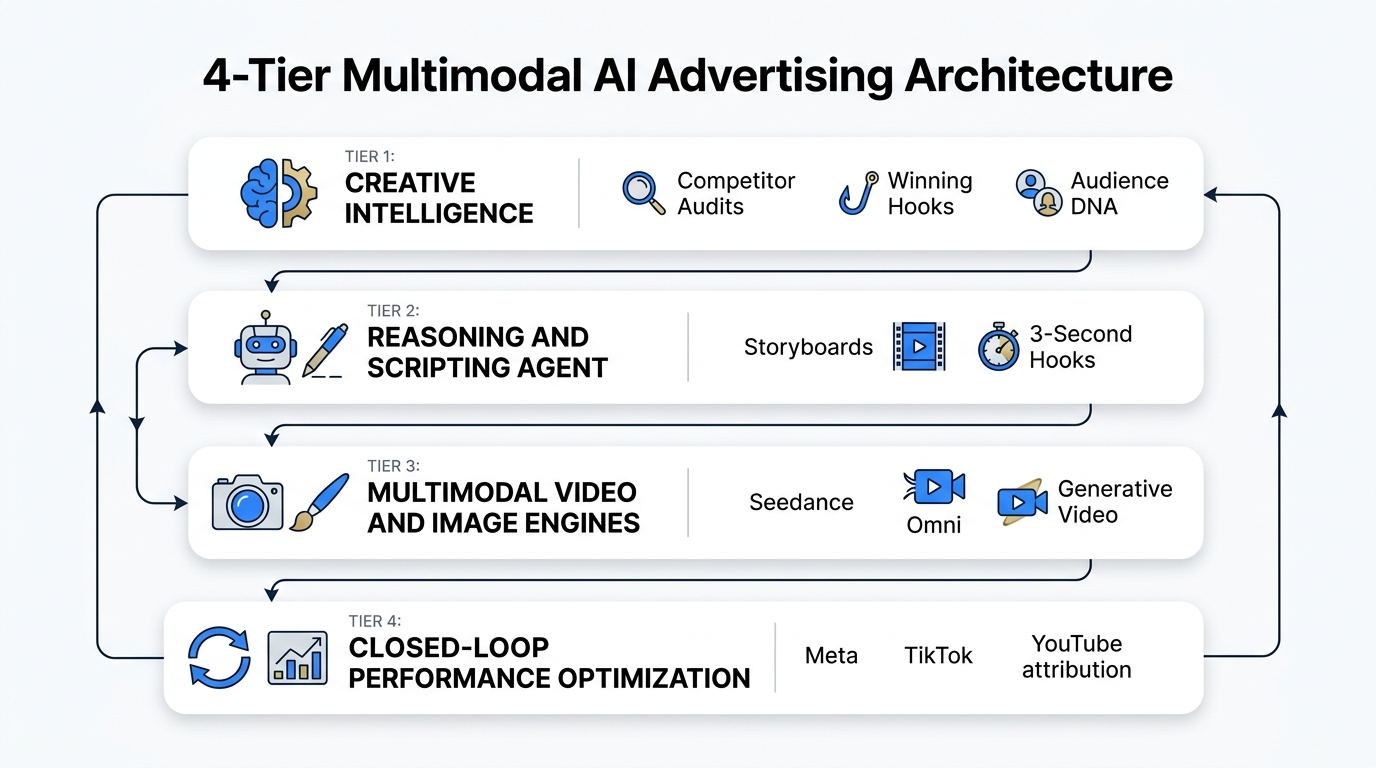
- Reasoning and scripting. Language models turn a product brief, past results and customer reviews into a script built for short-form attention.
- Video and image generation. Models such as Seedance 2.5, Gemini Omni and MiniMax H3 turn keyframes and references into motion. A multi-model canvas lets a team pick the model per shot.
- Voice and audio. Synthetic voices handle narration and localization without a studio session.
- Performance feedback. Retention and conversion data flow back to the scripting layer. A read-only Meta connection brings results in without publishing ads.
From prompting to directing a workflow
Traditional production is linear. A brief becomes casting, a shoot, an edit and a delivery, and a reshoot restarts the chain. AI production runs the same stages in parallel, which is why the unit of work shifts from "a video" to "a batch of hypotheses."
| Stage | Traditional production | AI creative workflow |
|---|---|---|
| Research | Manual desk research | Teardown of winning competitor ads across roughly 60 to 70 signals |
| Concepting | A few storyboard directions | Several hook hypotheses from one brief |
| Production | Shoot with cameras, talent and crew | Generation guided by stored brand references |
| Adaptation | Manual re-editing per ratio | Output format set in advance (aspect ratio, length, language) |
| Iteration | Reshoot scheduled | Re-render one scene |
Three habits make that table real.
Store brand context once
Vague prompts produce generic ads. Save the constraints first: colors, approved product angles, character likenesses, tone and messaging guardrails. In AdSmash you store these once and reuse them across generations, so a new ad starts on-brand instead of from zero.
Test different ideas, not different colors
A launch should test several psychological angles side by side: a problem hook, a social-proof opening, a curiosity gap, a direct demonstration. Ten recolors of one script are one test.
Direct the scene, not the whole video
If one shot needs a tighter product close-up, re-render that shot and keep the rest. On AdSmash's canvas you adjust scene by scene, so character and product stay consistent across the edit.
Do not crop a 16:9 video into 9:16. Compose vertical ads natively, with the product in the visible center and clear space for the platform's interface overlays.
Do AI-generated ads perform?
It depends on what you test and how you measure it. The format can work; whether it works for your account is an empirical question.
What AI changes is the cost of asking that question. A team limited to a handful of new ads a month learns slowly. According to the AdSmash homepage, the managed service can deliver 15 to 20 ads a week, which makes a weekly test cadence realistic without a studio.
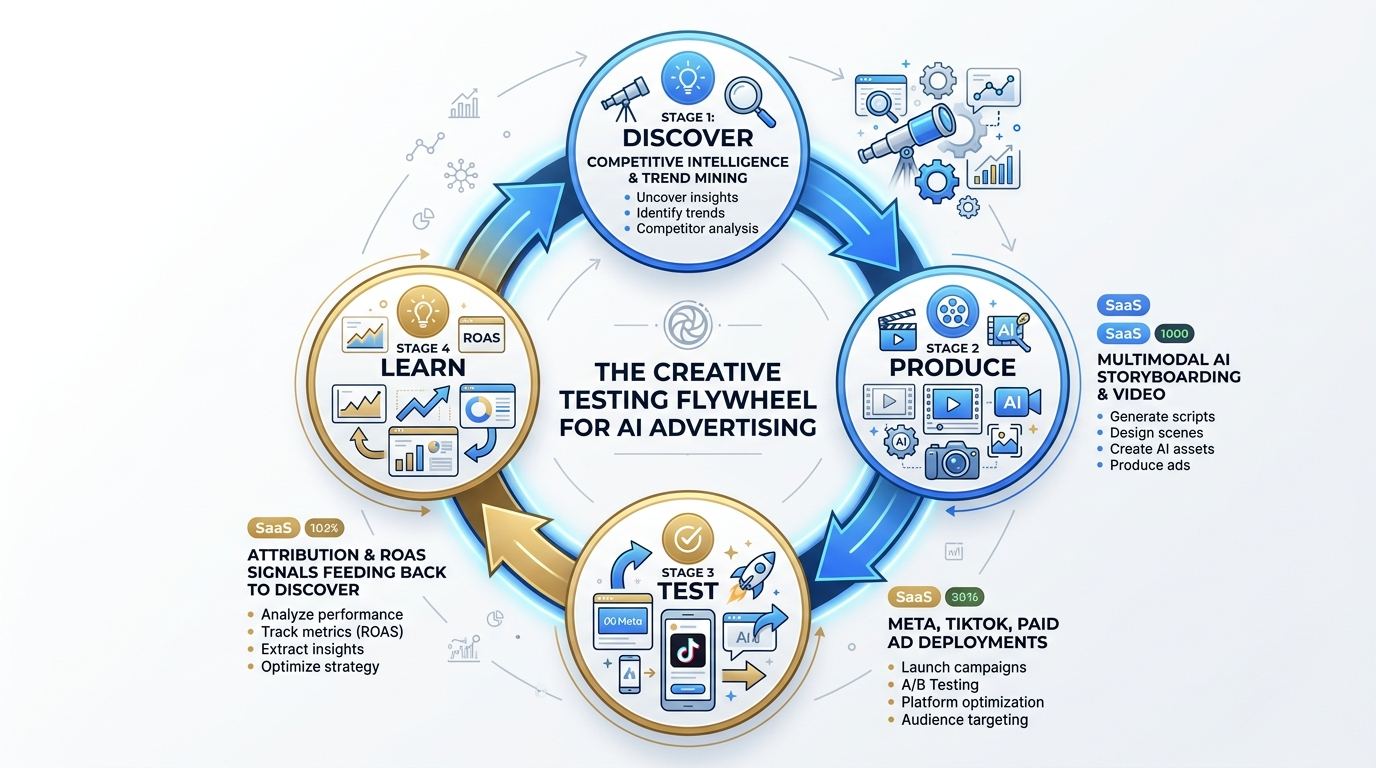
Volume only helps when the ads differ, and it only pays off if the clicks convert; our post on why ads get clicks but not conversions covers the second half. Our view is that a hundred visual tweaks of a weak script will not lift ROAS, while a dozen distinct angles can. For the math on how many distinct tests you need, see our creative hit rate analysis, which draws on Motion's benchmark of 578,750 creatives.
What to check before an AI ad ships
AI-generated ads face the same consumer-protection rules and platform policies as any other ad. Governance belongs in the workflow, not after it.
- Claims: document every statistic, clinical claim and guarantee before publishing.
- Brand fidelity: confirm product shape, color and branding match the real product.
- Likeness and voice: keep documented clearance for every avatar, voice and influencer reference.
- Disclosure: apply a platform's AI label wherever its policy requires one.
- Human QA: review every frame for artifacts and invented details.
Language models write enthusiastic copy by default, so unsupported promises are the most common risk. Digital replicas of real people need explicit, documented licensing. A fully synthetic avatar or a cleared talent agreement avoids the problem.
Disclosure rules differ by country and platform. According to the IAB AI Transparency & Disclosure Framework V2, advertisers should disclose AI use where it could materially mislead a consumer, and the IAB AI Governance Playbook sets out practices for data privacy and model transparency. Treat both as industry guidance, not law, and check each platform and market you run in. This is not legal advice. Our comparison of AI UGC ads and traditional production covers the testimonial rules in more detail.
On the human QA step, the managed service sends every ad through a human review before it ships. Self-serve plans do not include that review, so build your own check from the list above.
Where AdSmash fits in the loop
Most generative tools work in isolation: one app for images, another for copy, a third for video. Brand voice drifts between them and performance data stays behind. One platform can hold the whole loop.
- Brand context, stored once. Products, likenesses, colors, typography, tone and hooks are saved and reused. You decide what to save.
- Many models, one canvas. Video and image models from Google DeepMind, ByteDance, OpenAI and MiniMax sit on the same canvas, with the cost shown before every render.
- Ad creative intelligence. It dissects winning ads, and one click turns a teardown into a brief. It is available on every plan, including Free.
- Two ways to buy. Self-serve plans (Free, Pro, Team), or a managed service where you send a brief and get human-reviewed ads.
Start with one loop
Pick one product. Store its brand context, write four briefs that each test a different angle, and compare the results against your CPA target before you scale any of them. Start free to set up your brand references and run a first teardown, or see the plans, including the managed service.
Sources
- IAB, Nearly 90% of Advertisers Will Use Gen AI to Build Video Ads
- IAB AI Transparency & Disclosure Framework V2
- IAB AI Governance and Risk Management Playbook
- IAB Generative AI Playbook for Advertising
- AdSmash platform overview
Frequently asked questions
What is AI-generated advertising?
AI-generated advertising is any paid campaign in which AI creates or substantially changes core creative elements, such as video footage, visual style, copy, voiceover or editing. AdSmash is an AI ad creative platform built for this work.
What are the three tiers of AI-generated advertising?
AdSmash sorts it into assisted copilots, where humans keep editorial control and use AI for single tasks; dynamic creative assembly, where AI builds permutations from approved building blocks; and agentic creative loops, where an AI agent builds the ad and uses performance data to plan the next round. The tiers are our own framework, not an industry standard.
Do AI-generated ads perform better?
It depends on what you test. More variants only help when each one carries a different idea. Ten visual tweaks of one script are one test, so the practical rule is to test distinct angles and hooks, then iterate on whichever wins.
What should I check before publishing an AI-generated ad?
Substantiate every claim, confirm that product shape, colors and branding are accurate, keep documented clearance for voices and likenesses, apply platform AI labels where a policy requires them, and review every frame for artifacts.
Does AdSmash review every ad with a human?
No. Human QA belongs to the AdSmash managed service, where ads go through a human review before they ship. Self-serve plans do not include it.